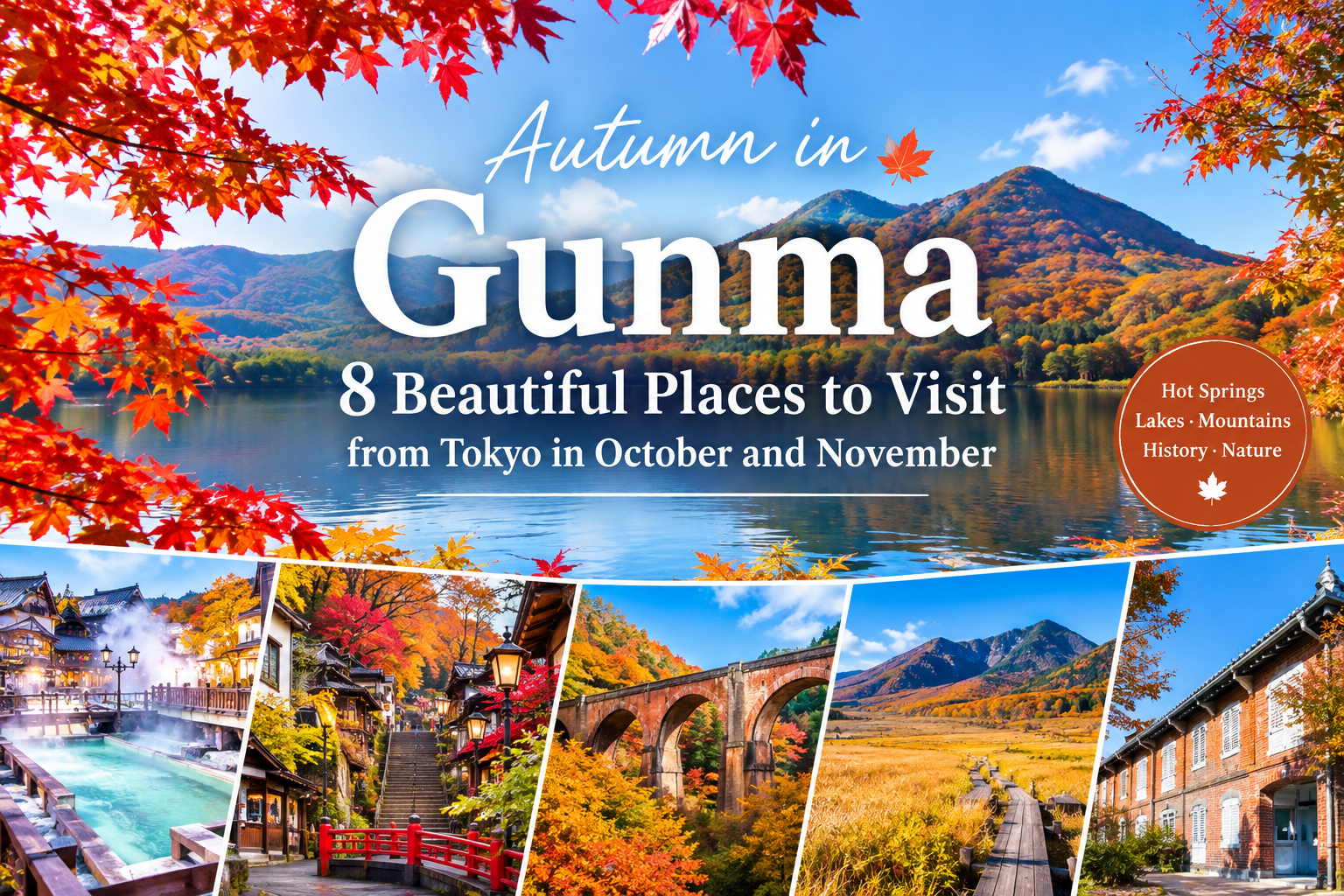
Kyoto and Nikko are famous for their autumn leaves. They are also among Japan’s busiest autumn destinations.
If you would like to see Japan’s autumn colors with more room to breathe, look north of Tokyo. Gunma Prefecture has steaming hot spring towns, volcanic lakes, mountain valleys, and a UNESCO World Heritage Site, and many of its best-known destinations are only a few hours from the capital.
- How to Get to Gunma from Tokyo
- Why October and November?
- 1. Kusatsu Onsen: One of Japan’s Most Famous Hot Spring Towns
- 2. Ikaho Onsen: 365 Stone Steps and Autumn Colors
- 3. Lake Haruna: Autumn Reflections in a Volcanic Crater
- 4. Shima Onsen and Lake Okushima: Quiet Onsen and Blue Water
- 5. Minakami and Mount Tanigawa: Mountains and Adventure
- 6. Megane Bridge: A Brick Bridge in the Mountains
- 7. Tomioka Silk Mill: A UNESCO World Heritage Site
- 8. Oze National Park: Golden Autumn Grasslands
- Which Places Should You Choose?
- A Simple 2-Day Itinerary from Tokyo
- Why Visit Gunma in Autumn?
How to Get to Gunma from Tokyo
Takasaki, the main gateway to Gunma, is only about 50 minutes from Tokyo Station by bullet train. Both the Joetsu and Hokuriku Shinkansen stop there.
Takasaki is your gateway to Gunma, rather than the final destination. From there you continue by local train or bus to the hot spring towns, lakes, and historic sites in this guide. Most places take about 2 to 3 hours from Tokyo, and the farthest take around 4.
Rail passes such as the JR Tokyo Wide Pass cover the Shinkansen to Takasaki and many local trains, but bus fares are usually paid separately.
Why October and November?
Gunma has a lot of high ground, so autumn colors arrive in waves. The high mountains turn first, in late September and early October. By mid-October the color reaches lakes and valleys at middle elevations, and in November it moves down to the hot spring towns and historic sites.
If you plan your route by elevation, you can enjoy autumn foliage for almost two months.
1. Kusatsu Onsen: One of Japan’s Most Famous Hot Spring Towns
From Tokyo: about 3 hours by limited express train and bus (a direct highway bus takes about 4 hours)
Best time: mid-October to early November, depending on the year
Kusatsu sits at about 1,200 meters, so its colors arrive early.
At the center of town is Yubatake (“hot water field”), where hot spring water flows through wooden channels and sends clouds of steam over the streets. It is especially atmospheric on a cool autumn evening.
Don’t miss Yumomi, a traditional performance in which the very hot water is stirred with long wooden paddles to cool it down.
Then walk about 10 minutes to Sainokawara Park, where a steaming stream runs through the autumn forest and a large open-air bath waits at the end of the path.
2. Ikaho Onsen: 365 Stone Steps and Autumn Colors
From Tokyo: about 2 to 2.5 hours by Shinkansen to Takasaki, local train to Shibukawa, then bus (a direct highway bus from Tokyo Station is also available)
Best time: late October to mid-November
Ikaho’s main street is a stone staircase of 365 steps, lined with small restaurants, cafés, souvenir shops, and traditional inns.
Climbing it slowly is the whole experience. Nearby, the maples around the red Kajika Bridge turn deep red and orange, and they are lit up at night during the season.
Because it is one of the easiest hot spring towns to reach from Tokyo, Ikaho works well for a short first trip.
3. Lake Haruna: Autumn Reflections in a Volcanic Crater
From Tokyo: under 3 hours by Shinkansen to Takasaki, then bus (about 25 minutes by bus from Ikaho)
Best time: mid-October to mid-November
Lake Haruna sits inside the caldera of Mount Haruna.
In autumn, the surrounding trees turn red and gold and reflect on the water. The cone-shaped Haruna-Fuji beside the lake makes a great photo, and a ropeway takes you to a higher viewpoint.
It is a good pick if you want big scenery without a long hike, and it pairs naturally with Ikaho.
4. Shima Onsen and Lake Okushima: Quiet Onsen and Blue Water
From Tokyo: about 3 hours by Shinkansen to Takasaki, JR Agatsuma Line to Nakanojo, then bus (the Limited Express Kusatsu-Shima from Ueno reaches Nakanojo in about 2 hours)
Best time: mid-October to early November
If you prefer a quieter trip, choose Shima Onsen.
This old hot spring town is spread along a river valley, with a nostalgic, small-town atmosphere. Further up the valley, Lake Okushima is known for its vivid cobalt “Shima Blue” water, which stands out against the red and yellow leaves.
The lake lies beyond the main hot spring town, so check the latest local bus timetable or consider taking a taxi.
The historic ryokan Sekizenkan is often said to have inspired the bathhouse in Spirited Away. Even if you haven’t seen the film, its old wooden architecture is worth a look.
5. Minakami and Mount Tanigawa: Mountains and Adventure
From Tokyo: about 2.5 hours by Shinkansen and local train to Minakami, then a 20-minute bus to the ropeway
Best time: mid to late October
Minakami is for travelers who like the outdoors.
A ropeway carries you from the base of Mount Tanigawa up to Tenjindaira in about 15 minutes, with wide views over mountainsides covered in red, orange, and yellow.
The area is also known for rafting and canyoning, and you can end the day in a hot spring.
The higher slopes change color earlier than the valleys, so timing matters.
6. Megane Bridge: A Brick Bridge in the Mountains
From Tokyo: about 2 hours to Yokokawa Station via Takasaki, then about 15 minutes by bus (the bus is seasonal, so check the timetable), or a walk of about 1.5 hours along the old railway trail
Best time: early to mid-November
Megane Bridge (Usui Daisan Bridge) was built in 1892 for a mountain railway.
It is the largest brick arch bridge in Japan, 91 meters long, with four arches and about two million bricks. The railway is gone, but you can walk across the bridge on the old track bed.
In November, the colorful leaves around it contrast beautifully with the dark brick.
It is also a convenient stop if you are combining Gunma with a trip to Karuizawa.
7. Tomioka Silk Mill: A UNESCO World Heritage Site
From Tokyo: under 2 hours by Shinkansen to Takasaki, then about 40 minutes on the Joshin Railway to Joshu-Tomioka Station and a 10-minute walk
Best time: any day, including rainy ones
Founded in 1872, Tomioka Silk Mill is Japan’s first modern silk factory and became a UNESCO World Heritage Site in 2014.
It played a major role in Japan’s modernization, and its red-brick buildings mix Western design with Japanese construction methods.
A discounted round-trip ticket that includes admission is sold at Takasaki Station.
It is also a good backup plan when the weather is poor.
8. Oze National Park: Golden Autumn Grasslands
From Tokyo: about 3.5 to 4 hours by Shinkansen to Jomo-Kogen and bus, or about 4 hours by direct bus (best as an overnight trip)
Best time: late September to early October
Oze is Japan’s largest mountain wetland, crossed by wooden walking paths.
In autumn its grasses turn gold, a scene called kusa-momiji (“grass autumn leaves”). Instead of looking up at red maples, you walk through a golden landscape surrounded by mountains. It is a very different kind of autumn from Kyoto’s.
Oze is not a quick day trip from Tokyo. Plan to spend a full day hiking, and consider staying overnight nearby.
Because of the altitude, the season comes early, so Oze works best as the first stop of an autumn trip.
Which Places Should You Choose?
| Trip style | Recommended combination |
|---|---|
| Famous onsen experience | Kusatsu Onsen |
| Two hot spring towns | Kusatsu Onsen + Shima Onsen |
| First 2-day trip | Ikaho Onsen + Lake Haruna |
| Quiet and traditional | Shima Onsen + Lake Okushima |
| Nature and adventure | Minakami + Mount Tanigawa |
| History and architecture | Tomioka Silk Mill + Megane Bridge |
| Early October | Oze + Minakami |
A Simple 2-Day Itinerary from Tokyo
Day 1: Tokyo → Takasaki → Ikaho Onsen. Climb the 365 steps, see the colors around Kajika Bridge, and stay overnight at a ryokan with a hot spring bath.
Day 2: Ikaho → Lake Haruna → Takasaki → Tokyo. Enjoy the lakeside scenery, then return to Tokyo by bullet train.
With more time, add Kusatsu Onsen or Shima Onsen.
Why Visit Gunma in Autumn?
Gunma isn’t as famous abroad as Tokyo, Kyoto, or Osaka, and that is its appeal.
You still get hot spring towns, ryokan, autumn leaves, mountain views, historic architecture, and local food, without spending your trip in a crowd.
So if you are visiting Japan this autumn, don’t just look south from Tokyo.
Look north. Gunma is waiting.
Travel times are approximate and depend on timetables. Check current train and bus schedules, and the foliage forecast, before you go.

コメント